Tuesday, December 3, 2013

Soil

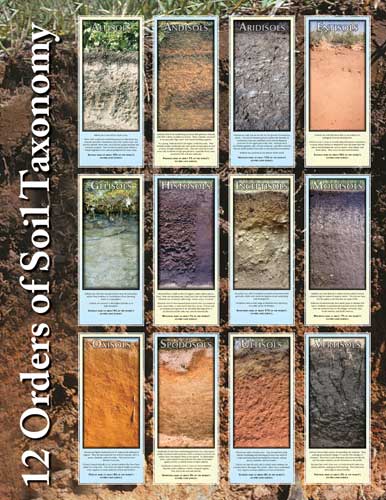
Twelve Soil Orders of the World

Alfisols- Great horizons for plants and grass and trees
Ultisols-reddish clays of Southeast
Inceptisols- found in hills; young and widespread
Andisols- volcanic ash rocks
Entisols-least developed but found far and wide; found in steep rocky slopes and riversides
Aridisols- desert sands
Gelisols- frozen
Vertisols- lots of cracks, made of clay, shrink and swell
Histosols- dark peats and mucks; soggy, wet, organic
Oxisols- tropical; red; low fertility
Mollisols- grow in corn fields; Midwest
Spodosols- low pH; pines in Coastal Plains

Soils Found in GA

Georgia: Tifton (Ultisol)


The Tifton series was one of the first series to be recognized in Georgia. Tifton soils occur throughout the Southern Coastal Plain in Georgia. They are the most extensive soils in Georgia. They occur on more than 2 million acres in the State. Tifton soils formed in loamy sediments of marine origin. They are among the most important agricultural soils in the State. About 27% of GeorgiaĆ­s prime farmland is in areas of Tifton soils. Cotton, peanuts, soybeans, and corn are the principle crops grown on these soils.

What is Micaceous Schist?

Schist is a crystalline metamorphic rock, mostly composed of more than 50% tabular and elongated minerals with grainsize coarse enough to be visible to the unaided eye. Schists have a developed tendency to split into layers.
Schists have a foliated or plated structure (schistosity). Schists are distinguished from other foliated rocks (e.g. slates and gneisses) by the size of their mineral crystals:
The crystals are larger than those of slates (macroscopically not visible) but smaller than those of gneisses (coarse grained, opposed to finely foliated schists). The protolith of schists can be igneous (e.g. basalt, volcanic tuff) or sedimentary (clay, mud).
Schists are classified and named on basis of their mineralogy:
The most common minerals of schist are mica; mica-schist contains quartz and mica (biotite or muscovite) as main minerals, schist is often named after additional minerals, e.g.


Tuesday, November 5, 2013

Urban Community Gardens

Urban community gardens are not a new concept but are increasingly becoming more popular in the United States. According to researchers, these gardens make up 15% of the country's agricultural resources. This is because people are realizing the numerous benefits these gardens have for the area as a whole and the people who live there. Urban community gardens were started as a way to introduce another food alternative in lower socioeconomic communities. By having these gardens, community member's have more food resources that are accessible by everyone. Families can get fresh produce from the garden instead of having to worry about spending money at a grocery store. In addition, the garden provides a healthy alternative. It was mentioned in one article that the urban communities usually have poor eating habits because of what is readily available to them. Now, with the healthier options in the gardens, families can provide more nutritious meals. Another benefit is the convenience of these gardens. Sometimes certain foods are not available in local stores, but with the community gardens, the people can come together and decide what they want to be grown. They may even grow items that are not in the stores just to have more options. As for the community as a whole, these gardens bring everyone closer together. Sometimes, this can be through a shared culture or tradition because they can grow common foods that everyone in that community enjoys. It gives people more pride in their community because these are maintained by the people. It is something that belongs to everyone. As far as environmental effects, community gardens make use of sections of land that might have gone to waste. They utilize these vacant lots by replacing them with safer, more appealing and vibrant gardens. Sometimes, the local gardeners/farmers take the waste from other supermarkets and turn that into compost for these gardens, so there's a little bit of recycling going on as well. Overall, community gardens increase the value of these urban areas and increase the morale of its inhabitants as well.

Sunday, November 3, 2013

Mercer Trees

"This remarkable tree is known as a 'living fossil', as it is the sole survivor of an ancient group of trees that date back to beyond the time of the dinosaurs. Ginkgo fossils are common in the rocks of the Jurassic and Cretaceous, but today Ginkgo biloba is the only member of its genus, which is the only genus in its family, which is the only family in its order, which is the only order in its class. The maidenhair tree remains virtually unchanged today and represents the only living bridge between 'higher' and 'lower' plants (between ferns and conifers). Maidenhair trees can be extremely long-lived, the oldest recorded individual being 3,500 years old." (Click on photo to learn more info)
"This short-trunked tree has long, drooping branches, a character which gives it its common name and helps distinguish it from other willows. Some of the longer branches may reach the ground. The bark is rough and gray. It is marked by long, branching ridges, resulting in rather deep furrows. It grows well, especially near water, and cuttings of twigs or branches root easily in moist soil. The Weeping Willow is a native of China and has been introduced into many parts of the World. In North America it is found from southeastern Canada southward and westward to Georgia and Missouri, and also can be found in western states. In Ohio this tree probably can occur just about anyplace where there is enough moisture and there are people to plant it. The Weeping Willow has been planted for shade and as an ornamental in the United States since colonial times. It is rapid growing, but short-lived compared to many other trees. Sometimes older specimens will become messy and unattractive when allowed to crowd buildings and to accumulate dead branches." (click photo to go to website about this tree)
"The Yoshino cherry tree (Prunus x yedoensis) is widely considered one of the most beautiful flowering ornamental trees. It is adaptable to a number of different soil conditions and can be grown in U.S. Department of Agriculture plant hardiness zones 5 through 8. The white to pink flowers combine with a light almond-like fragrance to make it quite a show-stopper. Along with its outstanding beauty, it also has a relatively fast growth rate and medium-sized stature, making it easy to incorporate into almost any landscape." (click photo for further info from this webpage)
"Pecan trees are commonly found surrounding both urban and rural dwellings throughout Georgia. They can enhance the environment and provide additional income from the sale of nuts. Pecans are recommended for home planting in the Coastal Plain and Piedmont, but are not recommended for the north Georgia mountains" (click photo for more info)

Mystery of the Megaflood

Through the study of rocks, scientists took on the controversial area 200 miles East of Seattle, known as the Channel Scablands. They noticed giant boulders (erratics) and enormous potholes that could not have been made by normal river processes. It seemed like the only thing that could have put the boulder there were ice glaciers, but that was ruled out too because being so remote, glaciers couldn't have reached the scablands. In 1923 Harlen Bretz hypothesized that the area was a result of some sort of great catastrophe that happened overnight. The hills had ripples in them, which looked like they could have been created by the sea. He came to the conclusion that they must have been created by a single giant flood. However, hypothesis didn't fare well because it sounded too Biblical. In order to convince his colleagues, he needed a source to explain where the water came from. The unusual marks on the bedrock in Montana was evidence of glaciers. They could have created Lake Missoula by damning the Clark Fork River. Joseph T. Pardee is the scientist who discovered the ripples years later and he wonder what caused the lake to empty. Iceland was 3000 miles away. The flood could have been a result of the melting of enormous mountains of ice. Due to super cooled water and hydrogen bonding, the water moved quickly through the ice, causing it to melt. Scientists created a mini Missoula in order to reenact this process and figure out how the flood could create extra features of scablands such as the potholes. This was found to be the result of bubbles that were formed when water was moving through the glaciers.

Wednesday, September 25, 2013

Ocmulgee Heritage Trail


The Ocmulgee  River Trail is the only riverside trail in middle Georgia. The addition of this greenway and riverwalk creates a safe place for people in Macon to enjoy the river. It creates a greater sense of community since more people come to spend time since the riverwalk has reduced the amount of troublesome visitors.
For more information about the Ocmulgee River Trail click here
To read an article about the Ocmulgee River Trail click here